
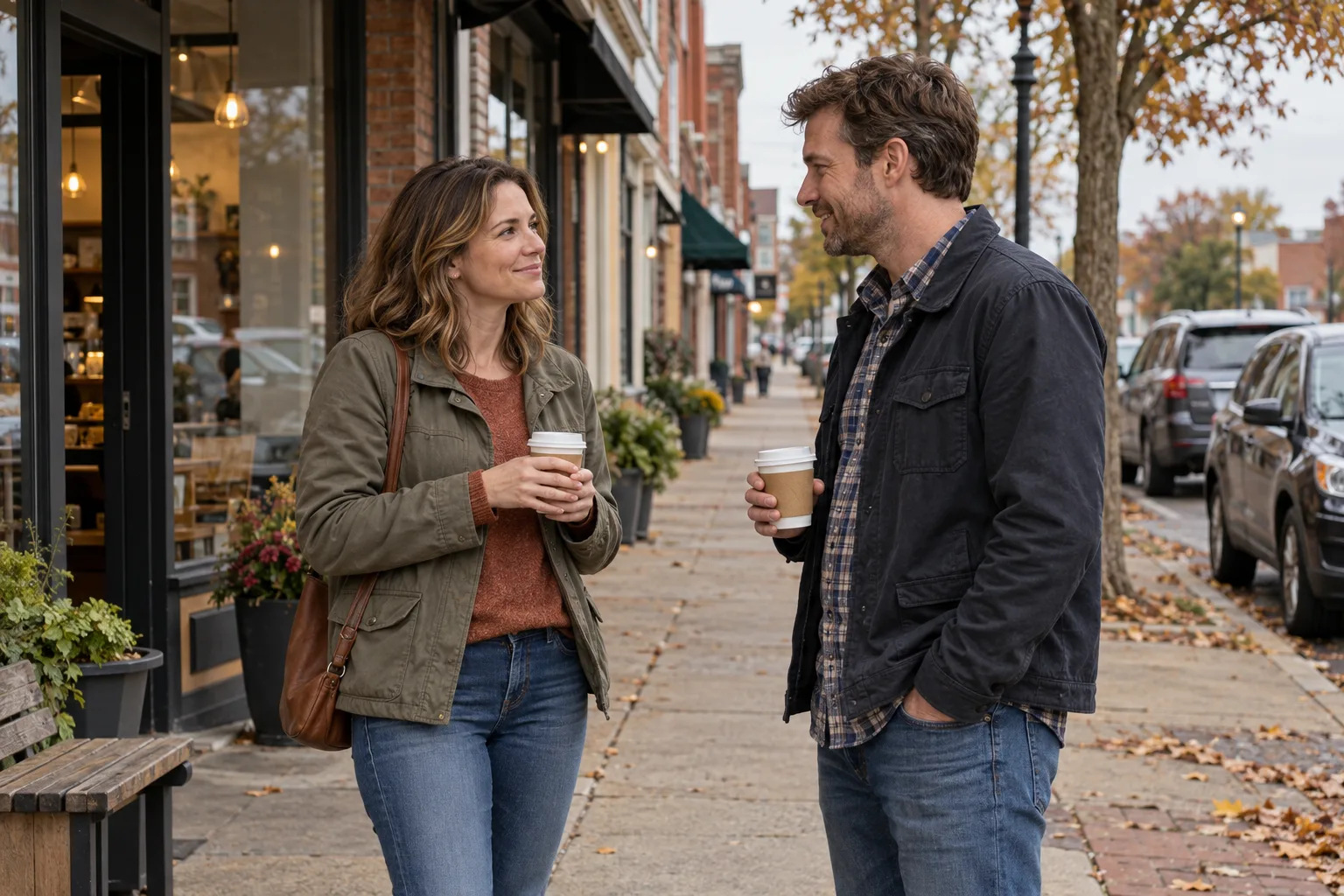
Dating with herpes in a small North Carolina town does not require publishing your health history or driving hours to feel anonymous. Start by limiting identifying details, choosing a public meeting place outside your usual routine when practical, and planning a private HSV conversation before relevant intimacy. You can reduce exposure. You cannot make any dating profile or public date completely invisible.
The awkward part may be ordinary recognition. A match mentions someone you work with. A restaurant server knows your family. You open a profile and recognize a person from the grocery store. None of those moments proves that your health information has traveled anywhere. Still, they can make dating feel less private than you expected.
This guide is for that practical problem. It does not assume everyone in a small town gossips, or that city dating is anonymous. It helps you decide what to share, where to meet, and what you will say if your social circles overlap.
The first decision: what do you actually want to keep private?
There are three different things here: being seen dating, being identified on a dating service, and having your HSV status shared. You may be comfortable with the first and worried about the third. Treating all three as equally dangerous can lead to rules that make it nearly impossible to meet anyone.
Try finishing this sentence privately: “If someone I know saw me, the part that would bother me most is…” Your answer might be a coworker discussing your personal life, an ex finding your profile, or someone forwarding health information. Each calls for a different response.
Keep the bio warm; make the identifying details less precise
A photo of you laughing beside a plain wall can tell a match plenty. A photo in a work uniform outside a recognizable business can tell them where to find you. In a community with overlapping circles, several harmless details can add up: your first name, a distinctive job, a weekly volunteer shift, and a familiar front porch.
Keep what makes a conversation possible. “I like cooking for friends and getting outside on weekends” gives someone an opening. The exact workplace and the hour you leave every Thursday add little to a first introduction. Use truthful information, but check whether the service lets you display a broader area instead of a precise location. Do not claim you live in Raleigh if you do not.
RAINN's safer dating guidance recommends keeping identifying details private while trust develops and avoiding photos reused on other public profiles. Consider a fresh, ordinary photo rather than a disguise. A real face helps someone recognize you at the meeting; an unrelated username can avoid connecting every account you use.
On a focused HSV service, the context itself may reveal something about your health even if the bio says nothing. Check what visitors and other users can see before uploading. If the question is specifically whether to name herpes in the bio, our guide to public profile wording and private disclosure handles that separate decision.
The second decision: familiar place or neighboring town?
A café you know offers useful comforts. You understand the parking, you can find the door, and you know whether the room stays busy. The cost might be running into someone familiar. A neighboring town offers a break from your routine, but adds travel and does not guarantee anonymity.
Our editorial view is that an easy exit matters more than being completely unrecognized. Do not swap a staffed, public place for an isolated overlook simply because nobody you know will be there. A scenic North Carolina location can be lovely for an established couple and a poor fit for a first meeting with a stranger.
Make the North Carolina map smaller, not your life
Think in workable routes rather than one statewide radius. Around Brevard, you might compare a local public meeting with an option toward Hendersonville. Near Morganton, you might consider whether a meeting toward Hickory actually fits your evening. In an eastern North Carolina community outside New Bern, the useful choice may be a staffed place along your normal route rather than a destination on the coast. These are planning examples, not claims about member availability or recommended venues.
Before agreeing, check the route at the time you would travel, the business's current hours, and how you will get home. Mountain routes, metro crossings, and a longer drive after work are different commitments. NCDOT's DriveNC traffic information is useful for current road conditions; it cannot tell you whether that trip fits your energy or budget.
The return-trip question
Ask yourself: “If we have a pleasant conversation but no chemistry, will I still feel okay about the journey?” If the answer is no, shorten the trip or start with a brief video call. A first meeting should not need a romantic outcome to justify the effort.
Agree on a manageable end time, travel independently, and give a trusted person the actual meeting details. You do not need to share your HSV status with that person to tell them where you will be. For location ideas once you have chosen a reasonable area, see our North Carolina first-date guide.
When a familiar face enters the picture
It helps to have one calm sentence ready. You do not need a complicated cover story. The examples below are invented wording suggestions, not accounts from members.
A neighbor sees you on the date
“Good to see you. We're catching up over coffee. Hope you have a good afternoon.”
A brief greeting lets the moment pass without explaining the relationship or the way you met. You can also simply introduce your date by first name if you both feel comfortable. Being seen sharing coffee does not require a health explanation.
A match says you have a mutual friend
“Small world. I keep dating separate from that circle while I get to know someone. I'd appreciate us leaving friends out of it for now.”
Look at the response. A person who accepts the boundary gives you more useful information than a person who immediately asks the mutual friend about you. You may decide the overlap is too close. You may also discover it feels manageable. Neither decision means you have failed at dating.
You recognize someone on an HSV dating service
Give them the discretion you would want. Do not screenshot their profile, tell a mutual acquaintance, or treat the service as proof of a specific diagnosis. If you do not want contact, check the platform's blocking or visibility options. Those controls differ by service, and blocking cannot undo anything already viewed or saved.
If someone comments on your own profile outside the service, a short response can be enough: “I keep my dating life private. Please don't share my profile.” You do not owe a public discussion of your health just because someone else found an account.
Privacy should leave room for an honest relationship
There is a difference between limiting an audience and keeping a potential partner permanently in the dark. Before sexual contact, discuss genital herpes with the person involved, including how you both want to manage risk. Oral HSV may also be relevant before kissing or oral sex. Ask a clinician about your situation; the CDC's herpes overview provides general health information.
Choose a moment without an audience, without a looming deadline, and without assuming that membership on the same dating service answers every question. Our HSV disclosure guide can help with wording. Here, the small-town question is what happens to that conversation afterward.
“I'm sharing this with you because we're considering being intimate. Please keep it between us. If you want health information, we can use a reliable source rather than involving people we both know.”
That is a reasonable request, not an enforceable promise of confidentiality. Another person may handle information badly despite your care. If someone threatens to share it, stop debating your diagnosis, keep evidence of the threat, and use the service's reporting tools where available. Tell a trusted person what is happening. If there is immediate danger, contact emergency services.
A small-town plan you can keep using
For the first few conversations, choose three limits: what will stay off your profile, which public meeting areas are realistic, and which personal details can wait until trust develops. Write them down for yourself. That way, an exciting match does not require you to renegotiate every boundary on the spot.
Then allow one part to stay flexible. Perhaps you try a café outside your weekly routine, or agree to a short call before driving. Expanding your options should make dating more manageable, not turn every meeting into an expensive secret mission.
You do not have to leave your town, announce a diagnosis to your social circle, or erase your personality to begin. If you are ready, explore the dating community after checking the registration service's current visibility settings. Start with the information you are comfortable sharing and a meeting plan you can genuinely follow through on.